Unveiling the role of erinacines in the neuroprotective effects of Hericium erinaceus: a systematic review in preclinical models
Spangenberg ET, Moneypenny A, Bozzo GG, Perreault ML (University of Guelph)
Frontiers in Pharmacology, 2025
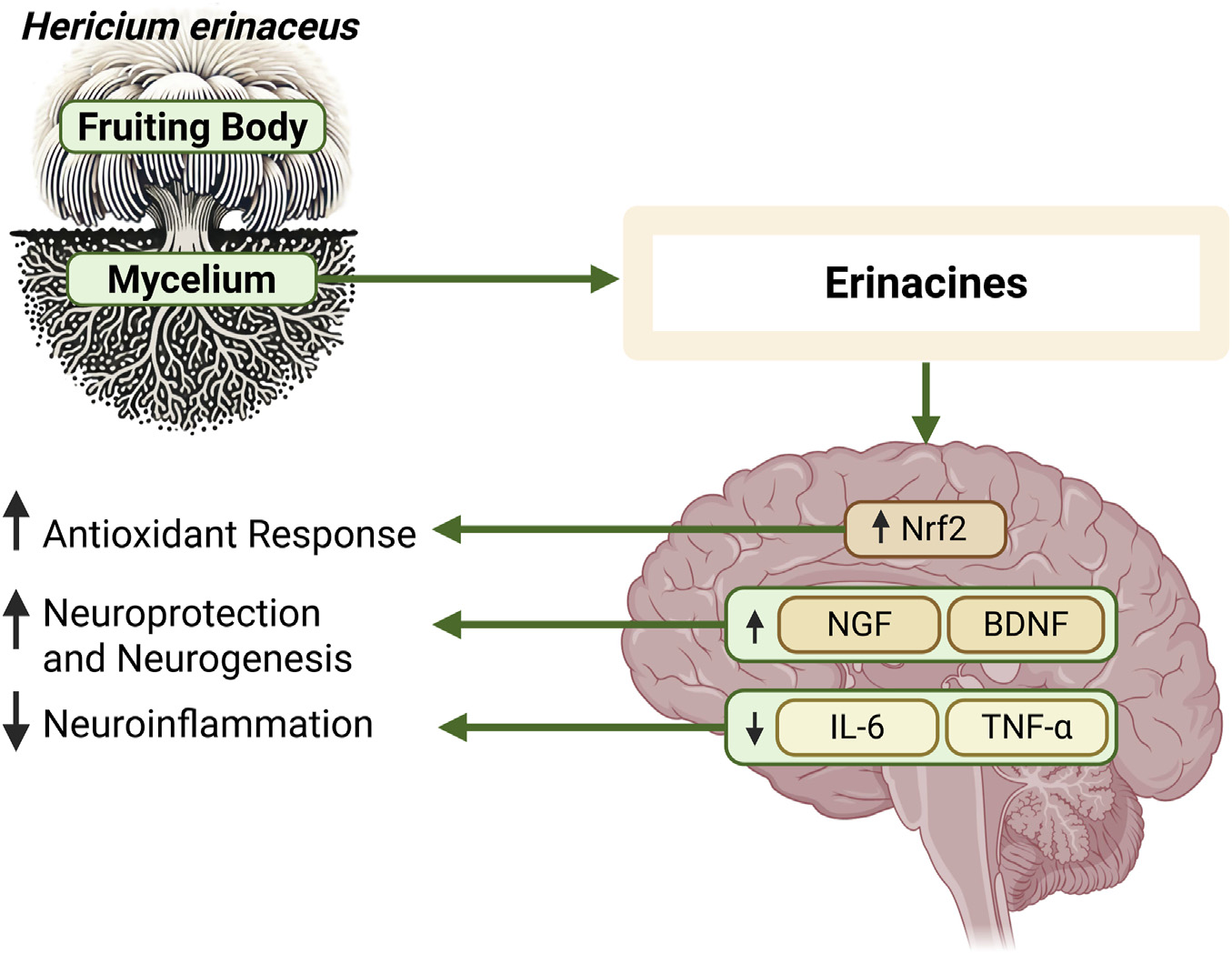
Systematic review: H. erinaceus mycelial formulations and their erinacines showed dose-dependent benefits in motor, cognitive and mood behaviours in animal models, activating antioxidant and pro-survival pathways in neurons.
Abstract
The medicinal mushroom lion's mane (Hericium erinaceus) is suggested to have therapeutic potential for neurological disorders due to its neuroprotective and neurotrophic properties. Mycelia of H. erinaceus contain erinacines, a group of cyathane diterpenoids, however no systematic review has explored the broader role of these compounds in mediating the neurobiological effects of the mushroom. This systematic review enhanced understanding of the neurobiological impact of erinacines using cellular and rodent models. A secondary focus assessed how outcomes were influenced by the chemical complexity of the treatments. PRISMA guidelines were used. Findings showed the broader potential of H. erinaceus mycelial formulations and their erinacines to exert dose-dependent benefits in motor, cognitive and depression-like behaviours in animal models. Both erinacines and H. erinaceus induced antioxidant responses and activated pro-survival signaling. Erinacine A and C uniquely induced accumulation of Nrf2, a key antioxidant-response regulator; they were also anti-inflammatory, enhanced neurogenesis and cell survival, and improved cognitive and behavioral outcomes in vivo. The findings suggest the promise of H. erinaceus extracts and individual erinacines as accessible, cost-effective interventions for aging-related and neurodegenerative conditions.
Keywords: erinacine, Hericium erinaceus, neuroprotection, neuroinflammation, cognitive function, neurodegenerative diseases.
Introduction
Natural therapies have grown popular as the list of medicinal plants and mushrooms with neuroprotective compounds grows. Early clinical trials showed effectiveness of many medicinal mushrooms for Alzheimer's, Parkinson's, depression, anxiety and sleep disorders. Effects are associated with primary compounds (fatty acids, sterols) and secondary metabolites including terpenes/terpenoids.
Lion's mane (Hericium erinaceus) is a vital part of traditional Asian medicine, used in nutraceuticals, known as a nootropic (“smart drug”). Nootropic effects were shown in early trials: improved cognition in young (19–45) and older (>55) healthy adults and in older adults with mild cognitive impairment.
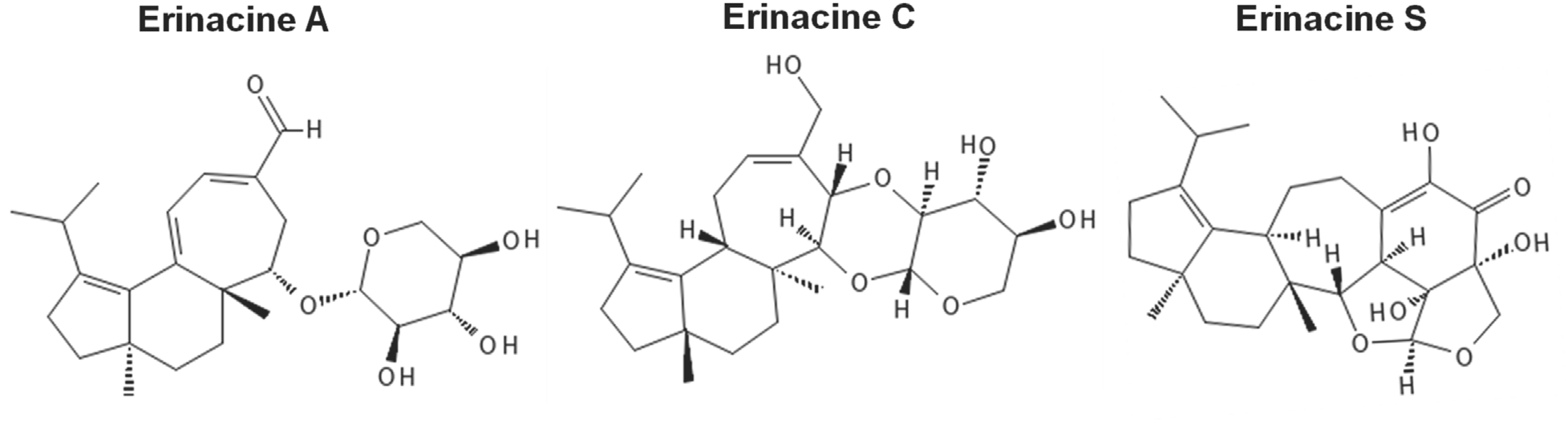
The mushroom has an external fleshy fruiting body from a substrate-bound mycelium. Both are neuroprotective but differ in bioactive molecules. Mycelia are rich in erinacines (cyathane diterpenoids with fused 5-, 6-, 7-carbon rings), while hericenones occur only in fruiting bodies. Some erinacines/hericenones cross the blood-brain barrier and stimulate neurotrophins – NGF, BDNF, NT-3 – which activate Trk receptors to promote neuronal survival, plasticity, repair. Hericenones A–H and erinacines A–C, H, I stimulate NGF synthesis in vitro, but only via glial cells. Erinacine A reduces neurotoxicity by activating pro-survival pathways.
Methods
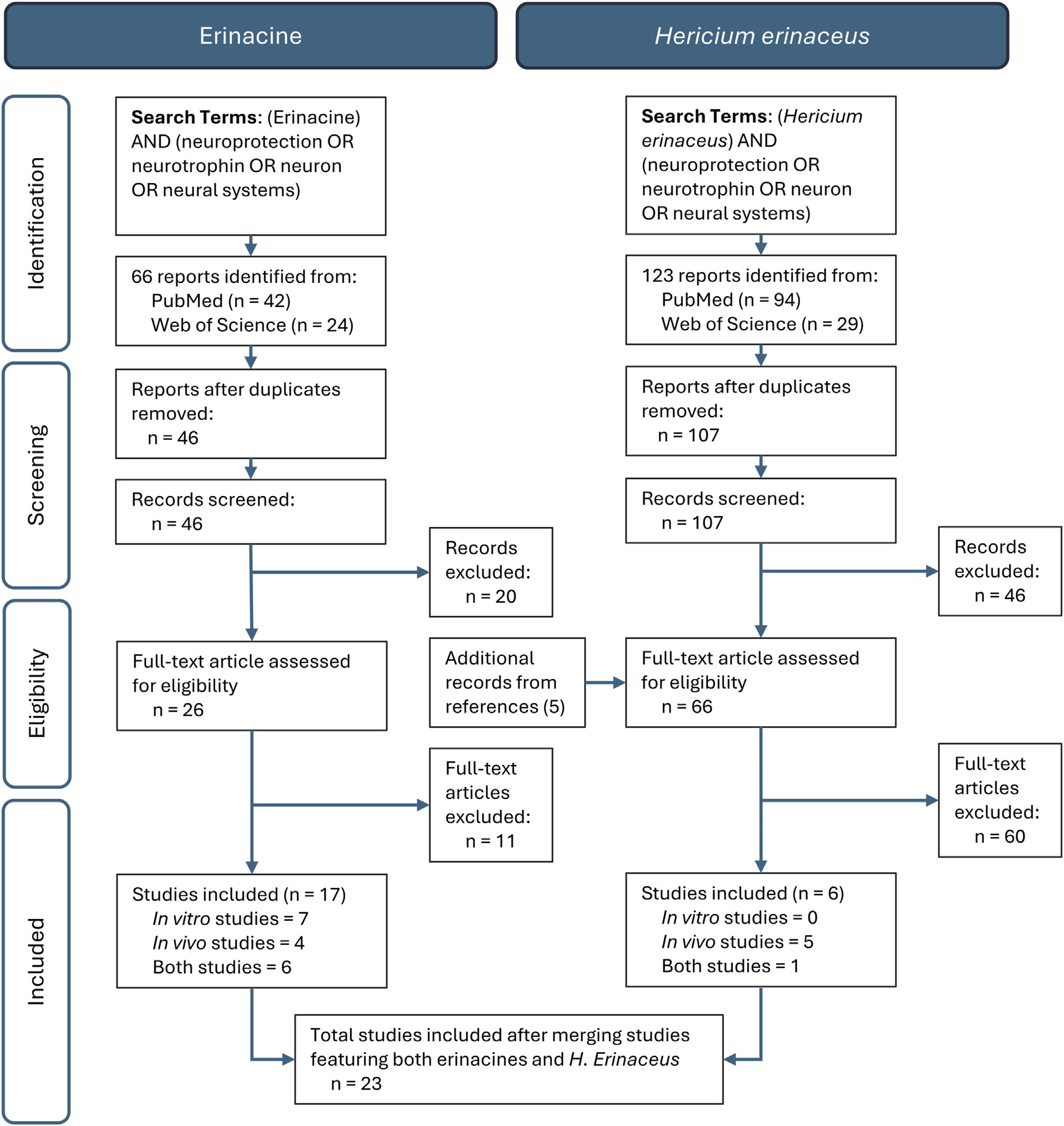
The review followed PRISMA. Two independent searches (Web of Science, PubMed, ScienceDirect, Feb 2024) on “erinacine” or “Hericium erinaceus” and (“Neuroprotection”/“Neurotrophins”/“Neuron”/“Neuronal System”). Included preclinical experimental studies (in vivo/in vitro) in English up to July 2024 reporting erinacine concentrations with a neurological cellular/molecular/behavioural outcome. Excluded: fruiting-body, bioavailability, compound-isolation, cancer models, no erinacine content, alternate Hericium species, and reviews/meta-analyses/abstracts. 23 studies were included.
Results – in vitro
Of 23 studies, erinacine A was most studied (12/17). Erinacines C and S in 7 and 6; only A, S, C were critically evaluated. In vitro used PC12 neuron-like cells and BV-2 microglia most often. A concentration-response trend was seen, but very high doses (>10 µg/mL) decreased SH-SY5Y viability (an efficacy window).
Anti-inflammatory/antioxidant/neuroprotective: erinacine A and mycelial extract (HEME) protected neurons by suppressing JNK and NF-κB; erinacines A and C inhibited TNF-α, IL-6, iNOS; erinacine A reduced MPP+ dopaminergic apoptosis; in glia-neuron cultures erinacine A preserved glutamate homeostasis (GLT-1); erinacine C induced Nrf2 and BDNF. Neurotrophic: erinacines enhanced NGF-induced neurite outgrowth (but not without NGF); erinacine A acted via TrkA/ERK1/2; only erinacine C raised BDNF.
Results – in vivo
Doses: oral 2.6–30 mg/kg/day (erinacines) or 75–1,000 mg/kg/day (mycelia, mostly 50–300), 9 days to 13 weeks. Behaviour: erinacine A (1 mg/kg) alleviated MPTP coordination deficits; motor improvements in Parkinson’s and after TBI (erinacine C); in sleep disruption HEM promoted exploration and lowered anxiety; HEME was antidepressant-like. Cognition: erinacine A improved spatial memory in AD models; erinacine S was analgesic for neuropathic pain.
Molecular: erinacine C after TBI via Nrf2/SOD1; erinacine A raised Nrf2 in optic neuropathy (Nrf2/HO-1/SOD1); in AD models erinacines/HEME reduced amyloid plaques and raised insulin-degrading enzyme (A > S); in Parkinson’s models erinacine A reduced dopaminergic neurotoxicity; HEME restored dopamine/serotonin/norepinephrine, raised BDNF, activated AKT (inhibiting GSK-3β).
Discussion & conclusion
Erinacines and H. erinaceus mycelia are neuroprotective via increased cell-survival factors and reduced oxidative stress/neuroinflammation (Nrf2, HO-1, SOD; lower IL-6, TNF-α, IL-1β). Behavioural effects are similar (motor, memory, instinctive behaviour), but cellular potency differs: erinacine A stronger against amyloid, erinacine S against neuropathic pain. Effects are generally dose-dependent.
Limitations: most studies did not assess sex differences (mostly males); lack of extract standardization and constituent quantification reduces reproducibility. Conclusion: erinacines uniquely activate Nrf2; erinacine C is promising via BDNF; erinacine S is analgesic. Given tolerability, low cost and accessibility, further study of H. erinaceus (TBI, anxiety, depression) is recommended. ⚠️ These are preclinical (cell/animal) data – human clinical confirmation is needed.
| Авторы | Соединение | Модель | Результат |
|---|---|---|---|
| Hsu et al. (2022) | EA | глия-нейрон, дефицит O₂/глюкозы | Сохранение функции GLT-1 и гомеостаза глутамата |
| Huang et al. (2021) | EA, ES, EC | кора крысы, OPC | EA/ES: ↑миелина, ↑зрелых олигодендроцитов |
| Lee et al. (2024) | EC | смешанная глия + BV-2, LPS | Защита нейронов через путь Nrf2 |
| Lee et al. (2020) | EA | N2a / нейроны, MPP+ | Предотвращение дофаминовой дегенерации |
| Lee et al. (2022) | EA | BV-2, N2a, LPS/IFN-γ | Подавление провоспалительных факторов |
| Lin et al. (2024) | EA, EC, ES | BV-2 + SH-SY5Y, LPS | Нейропротекция, ↓воспаления |
| Lin et al. (2023) | ES | кора мыши, ганглии | Рост нейритов, регенерация аксонов |
| Rascher et al. (2020) | EC | PC12 + среда астроцитов | ↑экспрессии NGF и BDNF |
| Rupcic et al. (2018) | EA,EB,EC,EZ1,EZ2 | PC12 ± среда 1321N1 | Стимуляция нейротрофинов |
| Wang et al. (2019) | EC | BV2, LPS | Активация Nrf2/HO-1, ↓iNOS |
| Wei et al. (2023) | EA, EL, EC, EF | PC12, BV2, LPS | Нейротрофическая активность, ↓NO |
| Wu et al. (2023) | HEME [EA 5 мг/г] | SK-N-SH, SCA3, tBH | ↑продолжительность жизни, ↓апоптоз |
| Yang et al. (2020) | EA, ES | SH-SY5Y | ES ↓ATP-индуцированный рост [Ca²⁺] |
| Zhang et al. (2017) | EA | PC12, кора крысы | ↑рост нейритов через TrkA и Erk1/2 |
| Авторы | Соединение | Модель | Результат |
|---|---|---|---|
| Chen et al. (2016) | EA, ES | мыши APP/PS1 (Альцгеймер) | ↓амилоидных бляшек, ↑инсулин-деград. фермента |
| Chiu et al. (2018) | HEME [EA 5 мг/г] | стресс, мыши (депрессия) | Норм. поведения, ↑BDNF, путь PI3K/Akt/GSK-3β |
| Hsu C.-H. (2023) | HEM [EA 30 мкг/г] | мыши MPTP (Паркинсон) | ↓окисл. стресса, ↑дофамина |
| Hsu C.-L. (2023) | EA | крысы, оптич. нейропатия | Нейропротекция, сохранение зрения |
| Hsu et al. (2022) | EA | мыши, ишемия | Сохранение функции GLT-1 |
| Huang et al. (2021) | EA, EC, ES | мозжечок крыс | EA/ES: ↑миелина |
| Lee et al. (2024) | EC | крысы, ЧМТ | Защита через путь Nrf2 |
| Lee et al. (2020) | EA | мыши MPTP | ↓дофаминовой дегенерации |
| Lee et al. (2014) | EA | крысы, ишемия/реперфузия | Нейропротекция, антирадикальный эффект |
| Lee et al. (2022) | EA | крысы, LPS-воспаление | ↓моторной дисфункции и нейровоспаления |
| Lee et al. (2021) | HEM [EA 5 мг/г] | мыши SAMP8 (старение) | ↑обучения/памяти, ↓окисл. стресса |
| Li et al. (2021) | HEM [EA 7,2 мг/г] | мыши, нарушение сна | Обратимость нарушений сна, ↓тревоги |
| Tsai-Teng (2016) | HEM/HEME [EA 19/104 мг/г] | мыши APP/PS1 | ↓амилоида, ↑нейрогенеза гиппокампа |
| Tzeng et al. (2018) | EA, ES | мыши APP/PS1 | ↑инсулин-деград. фермента, ↑NGF; EA: ↓Aβ |
| Wu et al. (2023) | HEME [EA 5 мг/г] | дрозофила SCA3, tBH | ↑продолжительность жизни, ↓апоптоз |
| Yang et al. (2020) | EA, ES | мыши, перевязка нерва L5 | ES обезболивал сильнее, чем EA |
Figures
References
- Chiu C-H et al. (2018) Erinacine A-enriched H. erinaceus mycelium produces antidepressant-like effects through BDNF/PI3K/Akt/GSK-3β. Int J Mol Sci 19, 341.
- Tsai-Teng T et al. (2016) Erinacine A-enriched H. erinaceus mycelium ameliorates Alzheimer’s-related pathologies in APP/PS1 mice. J Biomed Sci 23, 49.
- Tzeng T-T et al. (2018) Diterpenoid/sesterterpene constituents of H. erinaceus ameliorate AD pathologies in APP/PS1 mice. Int J Mol Sci 19, 598.
- Lee K-F et al. (2024) Cerebral protective effect of novel erinacines on mild TBI via Nrf2-dependent pathways. Antioxidants 13, 371.
- Zhang C-C et al. (2017) H. erinaceus constituents promote neuronal survival and neurite outgrowth via TrkA/Erk1/2. Int J Mol Sci 18, 1659.
- Mori K et al. (2009) Improving effects of Yamabushitake (H. erinaceus) on mild cognitive impairment: double-blind placebo-controlled trial. Phytother Res 23, 367–372.
- Полный список из ~50 источников – в оригинальном PDF. / Full ~50-reference list – in the original PDF.